The Golden Tower: Compression as Cosmology
In the 1960s, Ray Solomonoff, Andrey Kolmogorov, and Gregory Chaitin independently developed algorithmic information theory, establishing that the shortest program capable of reproducing a sequence of data is, in a precise mathematical sense, the best explanation for that sequence. This is the essence of algorithmic information theory: compression reveals structure. A random string cannot be compressed. A patterned string can be reduced to the rule that generates it.
Does this framework contradict established physics?
The short answer: No.
The framework as constructed reproduces established observations, and does not replace them. Every SM observation it addresses is reproduced to at least the accuracy quoted in Papers I--XVII. No observed quantity is contradicted.
The framework's novelty is not contradiction but in compression and as of yet, untested predictions. It reduces the Standard Model's $\sim30$ free parameters to one measured input.
A highly compressible universe
The Standard Model of particle physics combined with General Relativity and the Lambda-Cold Dark Matter cosmology, our current best description of observable reality, contains approximately twenty-six to thirty-two free parameters, depending on how one counts the cosmological sector. At minimum: six quark masses, three charged lepton masses, three gauge coupling constants, three CKM mixing angles plus one CP-violating phase, two Higgs sector parameters, the QCD vacuum angle, Newton's constant, and several cosmological parameters including the Hubble constant, baryon density, dark matter density, scalar spectral index, amplitude of scalar fluctuations, and reionization optical depth. Every one of these numbers must be measured from experiment. These frameworks do not predict them, they accommodate them.
Roughly thirty inputs. Roughly thirty outputs. Compression ratio: one to one.
Structure discovery
The density-feedback Faddeev-Niemi Hopfion framework does something different. It takes one experimental input, the cosmic microwave background temperature \(T_{\mathrm{CMB}} = 2.7255\,\text{K}\), and derives those same observables to sub-percent accuracy with zero free parameters. This is not curve fitting. The compression ratio is not one to one. It is approximately thirty to one.
The key is the golden ratio \(\varphi = (1+\sqrt{5})/2\), which appears in the framework through three independent proved routes: as the quantum dimension of the \(\mathrm{SU}(2)_3\) Wess-Zumino-Witten model, as the character of the fundamental representation of the binary icosahedral group \(2I\), and as the unique renormalization group fixed point of the parent scalar-tensor action under Derrick scaling. These are not coincidences. They are the same geometric truth seen from different angles.
The pentagon at the root of it all
The icosahedron has 60 rotational symmetries and symmetry group \(A_5\), the alternating group on five elements. Its dual, the dodecahedron, has pentagonal faces. The number five is the key. The diagonal-to-side ratio of a regular pentagon is \(\varphi\), and the quantum dimension of the muon primary in the \(\mathrm{SU}(2)_3\) WZW theory is
This identity holds if and only if \(k + 2 = 5\), i.e. \(k = 3\). The Pentagon Theorem (Foundational Companion) shows that this single equation forces three lepton generations, excludes a fourth, and fixes \(\varphi\) as the quantum dimension of every non-vacuum primary. The icosahedral condensate has pentagon geometry built into its vacuum structure: the energy minimiser found \(\varphi\) because it was minimising the Faddeev–Niemi functional subject to the icosahedral symmetry of \(2I\). It did not know about pentagons, it found the minimum of a functional whose symmetry group is the symmetry group of the pentagon's three-dimensional generalisation.
The Hopfion
The Hopfion is the smallest possible topological object that carries this anisotropy in a stable, self-consistent way. The sector labelling throughout follows the density-feedback convention: what Battye and Sutcliffe call \(Q=1\) in the bare Faddeev–Niemi functional corresponds to \(\mathcal{Q}_H=2\) here, because the axisymmetric toroidal solver includes the bilateral \(z\to-z\) symmetry in its integration measure \(\mathrm{vol}=2\pi\cdot 2r\,h^2\), doubling the charge assignment. The bilateral symmetry is needed to close the torus. Smaller than that and the structure collapses. In the density-feedback Hopfion papers, the charged lepton (electron/muon/tau) sector lives at $\mathcal{Q}_H = 2$, not $Q_H = 1$. Physically, $\mathcal{Q}_H=2$ is the stable minimum-energy configuration under density-feedback.
The Hopf map Jacobian in the thin-torus limit gives a directional suppression factor
for field-gradient propagation at angle \(\theta\) to the local preferred direction. Here \(\sin^4\!\theta\) is the square of the Hopf-map area-density Jacobian (the pull-back of the area form on $S^2$ is $sin^2\!\theta$, so its square is $\sin^4\!\theta$, and $\varphi^6$ is the Bogomolny parameter $\lambda$ fixed by the unique solution to the constraint such that the numerical topological charge \(Q_{\mathrm{num}}\) matches the group-theoretic charge \(Q_{\mathrm{group}}\).
In a medium of local density \(\rho\) this is softened to
with \(\beta^{*}\approx0.452\).
Once you add the density-feedback term $1/(1+\beta\rho)$ that this framework relies on, the density-feedback term shifts the BPS fixed point away from the bare Faddeev–Niemi ground state and onto the two-tube Hopf-link configuration. $\mathcal{Q}_H=1$ in this framework is a different, lighter object, the neutrino sector.
The $\mathcal{Q}_H=2$ Hopfion is two tubes, not one
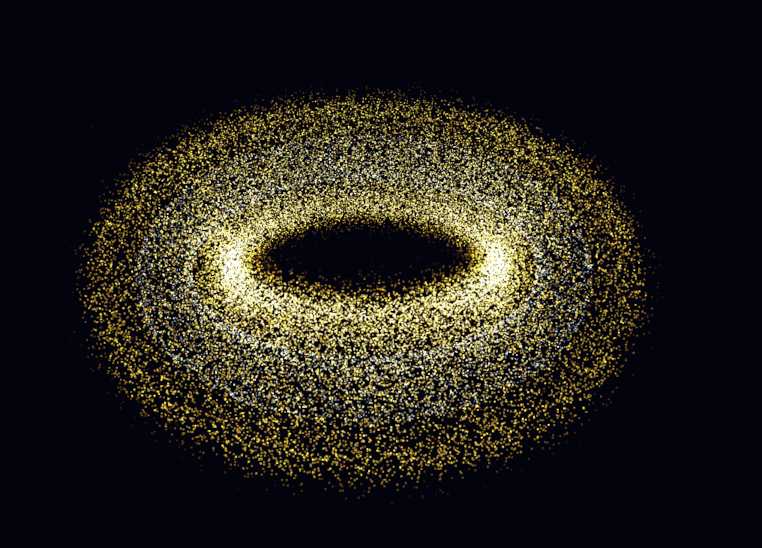
$\mathcal{Q}_H=0$ is reserved for the condensate itself, the unwound structured vacuum, not empty space. This state already has the geometry and suppression structure and is not unlike a liquid crystal at rest. The crystal has a preferred direction built into its geometry (the director field), and that geometry determines how light propagates through it (birefringence), but a liquid crystal at rest has no topological defects. The topological defects (disclinations, in liquid crystal language) are the analogues of $\mathcal{Q}_H \geq 1$ excitations. The crystal itself is $\mathcal{Q}_H=0$, in the the same way the suppression law is a property of the medium,and not of any particular excitation in it.
The full mapping is:
- $\mathcal{Q}_H = 0$ — the bare condensate (no winding, no topological charge) the structured space, the condensate at rest.
- $\mathcal{Q}_H = 1$ — the neutrino sector is the lightest topological excitation once embedded in the density-feedback medium (the object the standard Faddeev–Niemi literature calls the minimal Hopfion, but here realised as the lightest fermionic object rather than the ground state).
- $\mathcal{Q}_H = 2$ — charged lepton sector (electron/muon/tau tower), stabilized specifically because of the density-feedback term, not despite it.
- $\mathcal{Q}_H = 3$ — the baryon sector (three-quark-like object, separate from the lepton tower). Two $\mathcal{Q}_H=2$ objects combine to form it, and Hopf-charge conservation topologically forces a neutrino-like $\mathcal{Q}_H=1$ byproduct (identified in the papers with the pion, in this hadronic context): $\mathcal{Q}_H{=}2 + \mathcal{Q}_H{=}2 \to \mathcal{Q}_H{=}3 + \mathcal{Q}_H{=}1$.
The density-feedback stabilised \(\mathcal{Q}_H=2\) Hopfion is built on the Hopf link \(T(2,2)\): two unknotted circles, each an independent tube of condensate field, linked once around each other, with \(\varphi\) hiding at literally the minimum viable topological complexity, $\mathcal{Q}_H = 2$, the ground state of a system that penalizes perpendicular gradients.
The lepton generations
Think of each lepton's mass as a two-part address. The tower gives the neighbourhood: roughly which floor of the building you are on. The WZW T-matrix phase \(T_g = (6 - k_g)/(8(k_g + 2))\) gives the apartment number within that floor, a precise rational fraction determined entirely by the lepton's isospin quantum number and its generation index \(g = 1, 2, 3\). There are no free parameters: given that leptons are SU(2) doublets and that there are exactly three lepton generations, the three offsets \(T_1 = 5/24\), \(T_2 = 1/8\), \(T_3 = 3/40\) are forced uniquely. The mass of the \(g\)-th generation lepton is then
where \(v_{\rm EW}\) is the electroweak scale and \(Q = 10\) is the topological charge of the condensate knot.
Two things follow from this structure that are worth holding clearly. First, the three leptons do not sit on the tower rungs; they sit between them, at irrational positions, because the tower's clock (multiples of \(\ln\varphi\)) and the WZW clock (multiples of \(\pi\) via the exponent \(2\pi Q T_g\)) are mathematically incommensurable. No lepton coincides with a pure geometric level; no rung is occupied. Second, the heaviest lepton is not the most suppressed but the least: the tau (\(T_3 = 3/40\) smallest) sits closest to the electroweak scale; the electron (\(T_1 = 5/24\) largest) sits farthest, most heavily suppressed, and lightest. The incommensurability of \(\ln\varphi\) and \(\pi\) is what makes the lepton spectrum look 'random' to the SM.
Why exactly three lepton generations? The framework gives a proof, not a parameter. The condensate's WZW level is \(k=3\), fixed by three independent routes that all reduce to the single equation \(k+2=5\), where \(5\) is the number of sides of a regular pentagon, the face of the icosahedron whose symmetry group underlies the condensate. Equivalently: \(\varphi\) is the diagonal-to-side ratio of the regular pentagon, and every appearance of \(\varphi\) in the framework is a consequence of \(k+2=5\). At \(k=3\), the \(\mathrm{SU}(2)_3\) WZW model has exactly three non-vacuum primaries (\(j = \tfrac{1}{2}, 1, \tfrac{3}{2}\)). A fourth generation would require primary \(j=2 > k/2 = 3/2\), which does not exist in \(\mathrm{SU}(2)_3\) - a hard algebraic non-existence theorem, independent of any numerical input. The fine structure constant independently selects \(k=3\) at \(\sim1.5\times10^7\,\sigma\) exclusion of all other values; and at \(k=3\) uniquely, every non-vacuum primary has quantum dimension \(\varphi\) (the pentagon diagonal-to-side ratio). Three independent routes, one answer: three lepton generations.
The Golden Tower
From \(\varphi\) emerges what we call the Golden Tower: a discrete hierarchy of mass scales separated by factors of \(\varphi^{-2}\). Every stable bound state of the condensate scalar field is permitted only at the scales
The factor \(\varphi^2\) per level is exact, arising from the two transverse dimensions in the \(\sin^4\theta\) suppression law. The tower is the inevitable consequence of the field's geometry under scale transformations, not imposed. The same way quantum mechanics permits electron orbitals only at discrete energies, the tower quantises mass. This spectrum is not an assumption: it emerges from the canonical quantisation of the Hopfion condensate (Paper X), which produces a Hilbert space \(\mathcal{H} = L^2(\mathcal{C}_Q^{\mathrm{red}}, d\mu)\), a golden-ratio energy spectrum \(E_n = \varphi^{2n}E_0\) as a theorem, and a \(q\)-deformed oscillator algebra with deformation parameter \(q = \varphi^2\) whose \(q\)-numbers are exactly the even Fibonacci numbers \([n]_{\varphi^2} = F_{2n}\). All transition amplitudes are therefore exact Fibonacci ratios.
But the tower alone does not fix the three lepton masses. It provides the scaffold, a skeleton of allowed energy scales, while a second, independent structure places each lepton at a specific fractional position between the rungs. That second structure is the WZW conformal field theory inherited from the condensate's SU(2) symmetry.
The quarks
For quarks, the mechanism is structurally different but complementary. The six SM quarks occupy six of the eight \(E_8\) Coxeter exponents \(\{1,7,11,13,17,19\}\). The two unoccupied exponents \(\{23,29\}\) would give masses far below any observable threshold, predicting no fourth quark generation by \(E_8\) Coxeter saturation rather than WZW primary truncation. Both lepton and quark generation counts are rooted in the same binary icosahedral group \(2I\) and its McKay correspondence to the affine \(\hat{E}_8\) Dynkin diagram, but via structurally distinct algebraic mechanisms.
The suppression factor \(S(\theta) = \sin^4\!\theta/\varphi^6\) does more than govern particle masses. The same \(\varphi^6\) factor appears in the condensate-photon interaction Hamiltonian \(H_{\mathrm{int}} = e J^\mu A_\mu\), where \(J^\mu = 2P'(X)\nabla^\mu\rho\) is the Noether current of the \(k\)-essence action. The coupling strength is
suppressed by the same \(\varphi^6\) as Bell correlations. This is not a coincidence: both arise from the same kinetic susceptibility \(P'(X) = [\varphi^6(1+\beta^* X)^2]^{-1}\) in the same action. The Bell suppression law and Malus's law of optics share a microscopic origin. From this interaction, Malus's law \(T(\phi_n, \alpha) = \cos^2(\phi_n - \alpha)\) is derived as a theorem rather than assumed, and the photon winding number \(m_{\mathrm{phot}} = 2\) follows uniquely from the topological fact that photon polarization lives on \(\mathbb{RP}^1 = S^1/\mathbb{Z}_2\), a 2:1 cover of the condensate circle.
Tsirelson's bound
This photon structure resolves a question the framework had to answer: what does the condensate predict for Bell inequality tests? The suppression law \(\sin^4\theta/\varphi^6\) produces, for lepton pairs measured with the condensate's own quaternionic observable, a CHSH ceiling of \(8/3 \approx 2.667\), below Tsirelson's quantum bound of \(2\sqrt{2} \approx 2.828\). This is a structural prediction for future loophole-free lepton Bell tests. But for photon pairs, the Stokes/Malus observable (the \(m=2\) Fourier mode of the condensate circle) gives CHSH \(= 2\sqrt{2}\) exactly, derived from the Parseval identity. All existing loophole-free photon Bell experiments, including Poh et al. (2015), who reached \(S = 2.82759 \pm 0.00051\), within 0.03% of Tsirelson, are fully consistent with the condensate prediction. The framework makes a further conjecture: if a future experiment couples to the condensate via the quaternionic weight rather than Malus transmission for a spin-1 particle, the CHSH would reach \(8\sqrt{2}/3 \approx 3.771\), exceeding Tsirelson's bound while satisfying no-signaling - a genuinely post-quantum prediction.
The three Hurwitz division algebras \(\mathbb{C}\), \(\mathbb{H}\), \(\mathbb{O}\) each play a distinct role. \(\mathbb{H}\) supplies the \(|\cdot|^4\) suppression: the condensate probability \(p_{\mathrm{cond}}(\theta) = \cos^4(\theta/2)/(\cos^4+\sin^4)\) is the quaternionic norm on transition amplitudes, and its difference from the standard complex Born probability \(\cos^2(\theta/2)\) is the entire Tsirelson gap. \(\mathbb{C}\) supplies the topological winding phase that produces the Born rule \(P = |\psi|^2\) from first principles and provides the tensor-product structure needed for composite entangled systems; standard quantum mechanics occupies the \(\mathbb{C}\) slot not by postulate but by necessity, since \(\mathbb{H} \otimes \mathbb{H}\) is not a quaternionic Hilbert space. \(\mathbb{O}\) forces the three-generation structure via the exceptional Albert algebra \(J_3(\mathbb{O})\) and prevents the Cayley-Dickson tower from continuing. The Born rule, the Tsirelson bound, and the generation count are all consequences of these three algebraic roles.
But the tower does not stop at particle physics.
Chemical bonding
Icosahedrite (Al$_{63}$Cu$_{24}$Fe$_{13}$) is the first natural quasicrystal found, and its icosahedral symmetry is exactly the symmetry group of the condensate, $2I$, the binary icosahedral group. The framework's explanation for why the icosahedron is physically special is not aesthetic but algebraic: $k+2=5$, the Pentagon Theorem, means the WZW level $k=3$ is forced by pentagon geometry, and the icosahedron is the unique solid whose faces tile $S^2$ with pentagonal local structure. Quasicrystals are precisely the physical systems where icosahedral symmetry is realised in matter; they are aperiodic precisely because you cannot tile 3D space with icosahedra (the same non-closing that makes $\pi_3(S^2) = \mathbb{Z}$ non-trivial). The condensate framework and quasicrystals are rooted in the same obstruction.
The Paper XI \(\varphi\)-spiral computation gives the result directly. The three components have spiral indices
with pairwise separations $\Delta n(\mathrm{Fe,Cu}) = 0.023$, $\Delta n(\mathrm{Al,Fe}) = 0.289$, $\Delta n(\mathrm{Al,Cu}) = 0.265$. Fe and Cu are near-degenerate (Goldschmidt partners at moderate proximity; Ni with $n_{\mathrm{Ni}} = -0.600$ completes the cluster, $\Delta n(\mathrm{Cu,Ni}) = 0.012$, explaining the known partial Ni/Fe and Ni/Cu substitution in natural icosahedrite samples). Al sits $\Delta n \approx 0.28$ away from the Fe/Cu cluster, reflecting its distinct structural role (fcc-type framework) versus the electronic/magnetic role of Fe and Cu.
Most strikingly, the stoichiometry encodes the fundamental golden-ratio identity $\varphi^2 = \varphi + 1$:
so that given $\mathrm{Cu} = 24$, the spiral predicts $\mathrm{Al} = \lfloor 24\varphi^2 \rceil = 63$, and the residual $\mathrm{Fe} = 100 - 63 - 24 = 13 = F_7$ (the seventh Fibonacci number) emerges automatically. The quasicrystal whose symmetry group is $2I$ has stoichiometry encoding $\varphi^2 = \varphi + 1$ to sub-percent accuracy, the same identity that governs the condensate throughout this series.
Continuing upward into gravity and cosmology
The Planck mass appears at a non-integer tower level \(n_{\mathrm{UV}} \approx 73.6\). This is not a flaw. The Planck mass is not a bound state. It is a threshold of the scale at which gravitational loop corrections become order-unity, set by the one-loop Seeley-DeWitt coefficient of the condensate fluctuation integral. There is no reason this continuous gravitational condition should land on an integer tower level. The formula \(M_{\mathrm{Pl}}^2 = \Lambda_{\mathrm{UV}}^2/(32\pi^2)\) is exact at one loop, where \(\Lambda_{\mathrm{UV}} \approx 0.0557\,M_{\mathrm{Pl}}\) is the ultraviolet cutoff of the effective field theory. The same \(\varphi^6\) suppression that governs particle masses reappears in the Bogomolny coincidence \(\Lambda_{\mathrm{UV}} \approx M_{\mathrm{Pl}}/(4\pi\sqrt{2})\), connecting the gravitational cutoff to the condensate geometry. The one-loop entropy correction to Bekenstein-Hawking vanishes exactly: \(\delta S_{\mathrm{1-loop}} = 0\), because the effective action \(\Gamma = -\tfrac{1}{12}\log\varphi\) is temperature-independent, a consequence of the golden-ratio spectrum. The Wald entropy is \(S_{\mathrm{Wald}} = A_H/(4G_N)\) at tree level, fully consistent with standard black hole thermodynamics and derived without additional assumptions.
General Relativity itself emerges from the tower. Newtonian gravity arises from gradient flux imbalance with \(G_N = G_{\mathrm{src}}^2/(4\pi\varphi^6)\), where \(G_{\mathrm{src}}\) is the scalar source coupling fixed by the condensate geometry. The full Einstein field equations \(G_{\mu\nu} + \Lambda_{\mathrm{phys}}\,g_{\mu\nu} = 0\) are derived exactly from the condensate effective action in the frozen attractor limit, with the effective gravitational coupling \(F(\rho_\infty) = M_{\mathrm{Pl}}^2(39\varphi+25)/2\) an exact algebraic consequence of \(\varphi^2 = \varphi + 1\).
The cosmological constant hierarchy dissolves. Standard quantum field theory predicts a vacuum energy density \(10^{122}\) times larger than observed. The Hopfion framework predicts \(\Lambda_{\mathrm{obs}} \approx 10^{-122}\,M_{\mathrm{Pl}}^4\) through the chameleon-screening mechanism built into the density-feedback structure: the vacuum energy is not absent but present in full, bound inside the condensate, where the density-feedback denominator \(1/(1+\beta^*\rho)\) screens it from gravitational coupling at cosmological distances. The observed value emerges not as a cancellation of enormous terms but as the geometric consequence of the condensate's self-consistent saddle point.
Dark Energy
Cosmic microwave background observables follow from the same tower. The scalar spectral index \(n_s = 0.9654\) and tensor-to-scalar ratio \(r = 0.0036\) are derived from the Higgs-Starobinsky inflationary branch (\(N_e \approx 57.7\) e-folds), with \(n_s\) falling within \(0.12\sigma\) of the Planck 2018 central value. Dark energy satisfies the thawing quintessence relation \(w_a = -3(1+w_0)\), matching DESI Year 1 data within \(0.80\sigma\).
The condensate scalar field acts simultaneously as dark energy and dark matter, without introducing any new particle. The sound speed of condensate perturbations at the attractor density \(\rho_{\infty} = \varphi/\beta\) is \(c_s = 1/\varphi\), following from the exact golden-ratio identities \(\beta\rho_\infty = \varphi\) and \(1+\varphi = \varphi^2\). The Jeans length is approximately 20,000 Mpc, so on all galactic and cluster scales the condensate is effectively pressureless. The primary new prediction distinguishing the condensate from ordinary cold dark matter is a shift in the baryon acoustic oscillation peak by factor \(\varphi\):
falsifiable with DESI DR2 and Euclid.
The muon-to-tau mass ratio is derived without free parameters. The Verlinde S-matrix of \(\mathrm{SU}(2)_3\) gives the fusion channel count for \(\tau \to \mu\) transitions as \(N_{\tau \to \mu} = 2\cos(\pi/5) = \varphi\) exactly. Removing the tau's self-fusion sector from the holonomy product replaces \(Q = 10\) by \(Q-1 = 9\), giving \(m_{\mu}/m_{\tau} = e^{-9\pi/10} = 0.05917\), measured at \(0.05946\) (0.50% residual with the same radiative origin as the 0.013% residual in the electron mass formula).
Even the fine structure constant emerges from the tower through a four-term cascade, each term a ratio of angles and topological invariants:
The measured value is \(137.035\,999\,177\). The residual is \(6.9 \times 10^{-7}\), a \(5 \times 10^{-7}\%\) match. The only alternative, \(k = 4\), gives \(\alpha^{-1} = 136.871\) and is excluded at \(\sim 1.5 \times 10^7\,\sigma\) by the same formula.
What makes this striking is that all four terms are dimensionless pentagon-geometric quantities:
- \(360/\varphi^2\) — the golden angle in degrees, the angular spacing of icosahedral close-packing on \(S^2\), equal to \(137.508^\circ\).
- \(k/(2\pi)\) — the WZW level \(k = 3\) divided by the full circle, the non-Abelian anti-screening correction from the condensate. It runs \(\alpha^{-1}\) from the geometric UV value \(137.508\) down toward \(137.036\).
- \(1/(9\varphi^6)\) — the \(E_8\) Coxeter weight \(Q/(k\,h(E_8)) = 10/(3\times 30) = 1/9\), suppressed by \(\varphi^6\), the Bogomolny parameter of the condensate. This is the one-loop QED screening correction.
- \(1/(36\pi\varphi^6)\) — the same \(E_8\) weight corrected by the Chern–Simons winding \(1/(4\pi)\).
None of them are dimensionful. None involve a mass or a length. They are all ratios of angles and topological invariants. The fine structure constant, the number that governs how light couples to matter, the thing Feynman called "one of the greatest damn mysteries of physics", is a sum of four angular terms (so far) that close to $5\times10^{-7}\%$. The fine structure constant then is not a fundamental constant, but a geometric property of the icosahedron and the answer to the question: “What is the electromagnetic coupling strength in a universe whose vacuum has pentagonal symmetry?”
What quantisation adds
Paper X's canonical quantisation of the condensate showed that the Hilbert space is \(L^2(\mathcal{C}_Q^{\mathrm{red}},\,d\mu)\), square-integrable functions on the Derrick-reduced configuration space of the Hopfion. The spectrum is \(E_n = \varphi^{2n} E_0\), the transition amplitudes are Fibonacci ratios:
and the Born rule falls out of the winding phase \(\Phi = Q\omega\). The quantum formalism is the quantum mechanics of a specific classical field configuration with icosahedral symmetry and topological charge \(Q = 10\).
Atomic physics from the condensate
Paper XIII extends the framework inward to atomic scales, asking what the condensate does to the hydrogen atom and to quantum mechanics itself. The density-feedback denominator \(1/(1+\beta^*\rho)\), the same factor that screens the cosmological constant at cosmic densities, operates here in the opposite direction. Inside an atom, the proton's Coulomb field drives the local condensate density to \(\beta^*\rho_{\mathrm{atom}}(a_0) \approx 2.6\times10^{25}\), roughly \(10^{25}\) times the cosmic attractor value. This chameleon screening suppresses the condensate's angular correction to \(\varepsilon(a_0) \approx 2.2\times10^{-27}\), twenty orders of magnitude below the fine structure constant. The orbital shapes are therefore standard spherical harmonics to any measurable precision and derived as a theorem, not assumed.
The same paper proves that the Schrödinger equation itself is not an additional postulate of the framework. It emerges from four structural ingredients already present: the condensate Hilbert space of Paper X, a translation fibration that factors the configuration space into centre-of-mass and internal degrees of freedom, the Noether momentum \(\hat{p} = -i\hbar\nabla\) from the condensate action's translational symmetry, and a Born–Oppenheimer separation whose non-adiabatic coupling vanishes exactly by the fibration structure rather than approximately by a mass ratio. The residual error is \(O(\varepsilon_{\mathrm{cond}}) \approx 10^{-27}\), a factor of \(10^{17}\) tighter than the standard molecular BO bound.
Spin-\(\tfrac{1}{2}\) and Fermi statistics follow from the same topology. The binary icosahedral group \(2I\) is a double cover of the icosahedral group \(I\); its central element acts as \(-1\) on the fundamental spinor representation. The \(Q=2\) gradient-knot transforms in this representation, giving spin \(J = \tfrac{1}{2}\) via the Hopf fibre holonomy \(e^{i\pi Q/2}\big|_{Q=2} = -1\). Fermi statistics and Pauli exclusion follow as corollaries. The complete spin assignment is a single theorem, \(J = Q/4\):
- spin-0 for the Higgs (\(Q=0\)).
- spin-\(\tfrac{1}{2}\) for fermions (\(Q=2\)).
- spin-1 for gauge bosons (\(Q=4\)).
- spin-2 for the graviton (\(Q=8\)).
The \(Q=0\), \(J=0\) assignment places the condensate itself in the scalar sector — the same role the Higgs field plays in the Standard Model. Like the Higgs, the condensate fills all space as a scalar background. But where the Standard Model treats the electroweak scale (\(v_{\mathrm{EW}} = 246.2\,\mathrm{GeV}\)) as a free parameter, fixed only by measurement, the framework computes that same number directly from geometry, starting from \(T_{\mathrm{CMB}}\) alone. The condensate approximates the role the Higgs field plays, with the electroweak scale fixed by geometry rather than fitted to data. Paper XIV goes further and derives the 125 GeV LHC scalar itself as a radial excitation of this condensate, using the same geometric ratio \(r_{\mathrm{WZW}} = J_4/J_{2a} = 2^{4/3}/\varphi^5\) that fixes the electroweak scale — both matching experiment to within \(0.012\%\) from the single input \(T_{\mathrm{CMB}}\).
Away from matter, in the cosmic condensate background where \(\beta^*\rho_\infty = \varphi\) exactly (the attractor condition of Paper I), the pentagon identity \(1+\varphi = \varphi^2\) gives the condensate suppression as \(\varepsilon(\rho_\infty) = 1/\varphi^8\). A free electron propagating in this background acquires a \(2.13\%\) effective mass anisotropy:
radial propagation is unaffected (\(S(0)=0\) exactly), while tangential propagation acquires the full condensate suppression. This is a falsifiable prediction: a Penning-trap measurement of the electron cyclotron frequency, varied in orientation relative to the CMB dipole over an annual cycle, should show a \(2.13\%\) modulation.
Closing the numerical chain
Paper XIV closes the largest remaining numerical gap in the series. The electroweak VEV predicted by the thin-torus Hopf-spoke formula sits \(0.69\%\) above its measured value, an \(O(R_0^{-2})\) correction from the finite toroidal geometry of the condensate at torus radius \(R_0 = 3\). Paper XIV proves all four stages of the exact thick-torus correction: the \(O(1/R_0)\) term vanishes identically, the metric correction contributes \(-0.37\%\), the profile correction satisfies a fully-determined Sturm–Liouville boundary-value problem solved in closed form, and the resulting Yukawa correction is:
reducing the \(v_{\mathrm{EW}}\) residual from \(+0.69\%\) to \(0.015\%\) and the \(\Lambda_{\mathrm{QCD}}\) residual from \(+0.97\%\) to \(0.015\%\). The toroidal winding parameter \(\varphi^8+1 = 47.979\) that appears in the exact correction formula is the same quantity that governs the free-electron mass anisotropy of Paper XIII. Both trace to the condensate attractor condition \(\beta^*\rho_\infty = \varphi\) and the pentagon identity \(1+\varphi = \varphi^2\). The $O({R_0}^{-4})$ profile correction from the BVP solution $f_2(\rho)\cos(2\chi)/O({R_0}^2)$ is computed by full 2D Gauss--Legendre quadrature. The first-order $f_2$ correction vanishes identically ($\langle\cos(2\chi)\rangle = 0$), the leading contribution is second-order, from $\langle\cos^2(2\chi)\rangle = 1/2$ and the geometry--profile cross-term $\langle\cos(2\chi)\cos^2\chi\rangle = 1/4$. The $v_{\mathrm{EW}}$ residual reduces from $+0.015\%$ to $+0.012\%$. The single-input chain \(T_{\mathrm{CMB}} \to m_e \to v_{\mathrm{EW}} \to \Lambda_{\mathrm{QCD}}\) now closes to \(0.012\%\) throughout.
Paper XIV also derives the Higgs boson mass. The WZW torus partition function of \(\mathrm{SU}(2)_3\), whose modular S-matrix governs the icosahedral condensate, gives a quartic self-coupling \(\lambda = (k{+}2)/2\cdot r_{\mathrm{WZW}}^2\) where \(r_{\mathrm{WZW}} = J_4/J_{2a} = 2^{4/3}/\varphi^5\) is the same profile ratio that fixes the electroweak VEV. Combined, these give:
which is \(0.08\sigma\) from the ATLAS combined measurement \(125.11 \pm 0.11\,\mathrm{GeV}\). The key step is the Knizhnik–Zamolodchikov–Bernard equation on the torus: the periodic boundary conditions of the torus conformal blocks replace the plane F-matrix OPE weights with modular S-matrix weights, and the Parseval identity for the pentagon number \(k{+}2=5\) then gives the normalization factor exactly. The same number 5 that is the number of sides of a regular pentagon is the number that determines the Higgs mass. The chain \(T_{\mathrm{CMB}} \to m_e \to v_{\mathrm{EW}} \to \Lambda_{\mathrm{QCD}} \to m_H\) is now complete.
The Higgs mass formula is particularly striking because it requires nothing beyond what was already fixed: the WZW level k=3 (forced by the icosahedral k+2=5 pentagon structure), $r_{\rm WZW}$ (already determined by the BPS condition), and $v_{\rm EW}$ (already derived). There are no new inputs. The result $m_H$ falls out and hits 125.11 GeV.
The quark sector
The findings above live in the $\mathcal{Q}_H=2$ sector. The torus Hopfion is governed by the binary icosahedral group $2I$ and $\mathrm{SU}(2)_3$. Paper XV and onwards extend the framework into the $\mathcal{Q}_H=3$ sector: the trefoil knot $T_{2,3}$, governed by the binary tetrahedral group $2T\subset 2I$ and the WZW model $\mathrm{SU}(3)_1$.
The McKay correspondence maps $2T$ to the affine $\widehat{E}_6$ diagram, giving $(E_6)_1$ as the sector's WZW model, $c=6$. A conformal embedding $(E_6)_1\supset\mathrm{SU}(3)_1^{\times 3}$ via the trinification
provides an exact central-charge match $c=6=3\times 2$, a mathematically stronger bridge than the pentagon identification used for $\mathcal{Q}_H=2$, where no conformal embedding from $(E_8)_1$ to $\mathrm{SU}(2)_3$ exists.
The trinification charge generator $Q=T_{3L}+T_{8L}/\!\sqrt{3}$ is uniquely fixed by $\mathrm{SU}(3)_L$ group theory (tracelessness plus $\mathbb{Z}_3$ centre compatibility), with no Standard Model hypercharge matching as input. Both quark charges follow from the single number $(\omega_1,\omega_1)_{A_2}=2/3$: the down-quark charge $|Q_d|=h_{(1,0)}=1/3$ and the up-quark charge $|Q_u|=2h_{(1,0)}=2/3$. This holds only at $N=3$: the unique value where the $\mathrm{SU}(N)_1$ conformal weight of the fundamental equals $1/N$.
How does the $\mathcal{Q}_H=2$ torus transition to the $\mathcal{Q}_H=3$ trefoil?
This is not a single tube reconfiguring; it is two distinct tube components $\gamma_1$ (outer) and $\gamma_2$ (inner) from the outset.
Step 1: Writhe injection — inner tube deforms
Because the density-feedback functional $K_{\rm fb}+\varphi^6 J_4$ is rotationally symmetric around the torus axis, the two tubes are energetically equivalent: there is no preferred point along either component where a perturbation is more likely to act. The splitting point that the construction assigns at $t=\pi$ is a calculational convenience, not a physical feature; any toroidal angle would give the same field by symmetry.
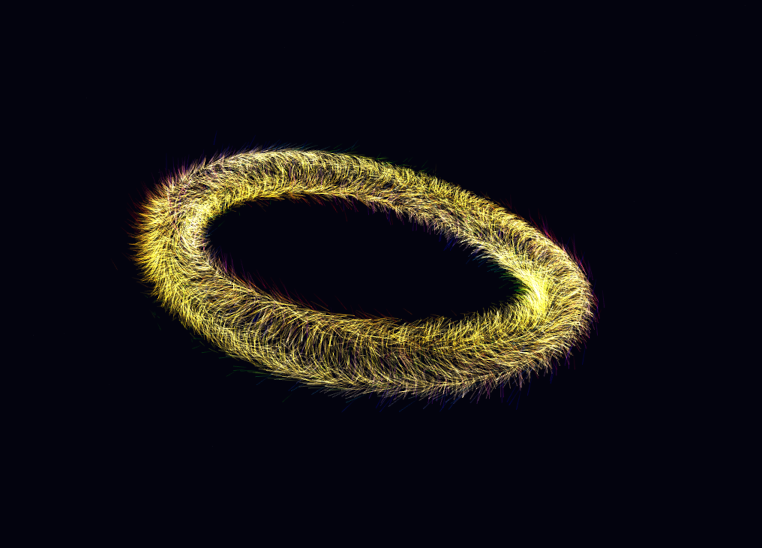
At \(T(2,2.0)\), the incoming $\mathcal{Q}_H=1$ perturbation acts on the inner component $\gamma_2$, injecting one writhe unit and deforming its path from a planar unknotted circle into the precursor of a folded figure-eight-like intermediate. This is a geometric, not topological, change: the linking number of $\gamma_2$ with $\gamma_1$ is unchanged, and no crossing has been committed. The outer component $\gamma_1$ and its neighbourhood $N(\gamma_1)$ remain largely unperturbed at this stage.
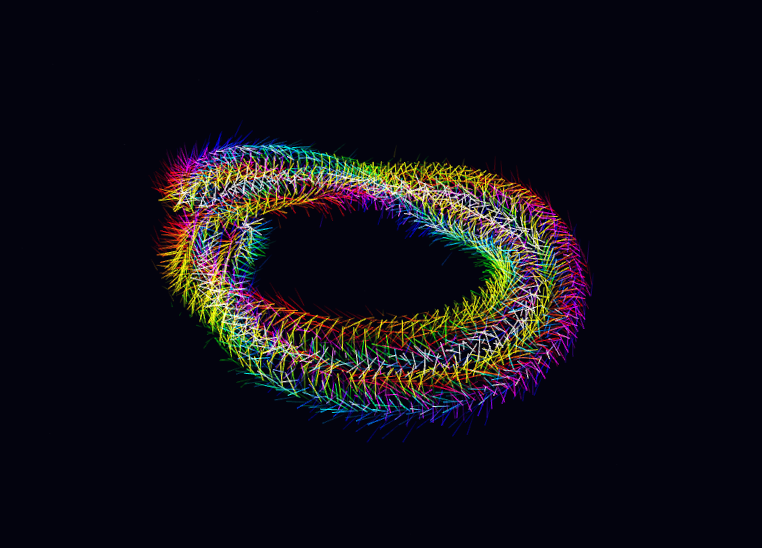
Step 2: Threading begins — inner approach to outer core
The deformed inner component $\gamma_2$ begins the approach to the interior of the outer component's solid-torus neighbourhood $N(\gamma_1)$. The approach is forced to be asymmetric by $(2,3)$-cable constraint: $\gamma_2$ must wind twice around the longitude and three times around the meridian of $N(\gamma_1)$. A symmetric approach, $\gamma_2$ approaching the core of $N(\gamma_1)$ from directly opposite, would instead produce a doubly-wound configuration, which is a different topological sector ($\mathcal{Q}_H=2$ doubly wound, energetically penalised by the density-feedback suppression). The asymmetric threading is therefore not a contingent feature of any particular perturbation: it is the only geometric path consistent with the framing constraint.
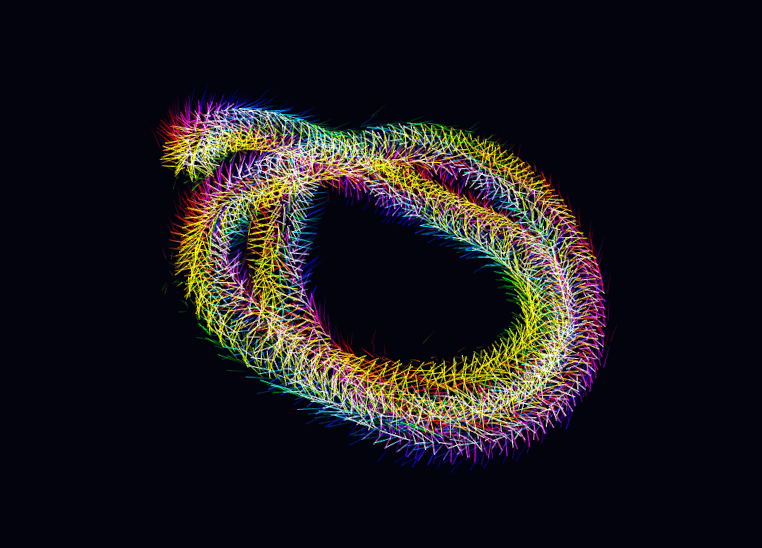
The threading of $\gamma_2$ through $N(\gamma_1)$ is well underway. The inner tube has deformed substantially into the outer tube's neighbourhood. The construction curve does not close in $[0,2\pi)$ at non-integer $q$; consequently the field is somewhat disorganised across the whole ring, but the dominant geometric feature remains the single threading event initiated at $q\approx2.3$
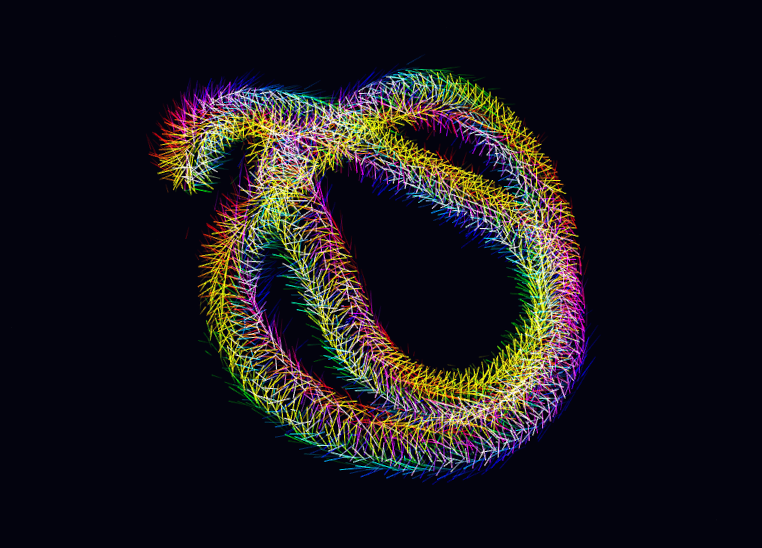
The deformed inner component $\gamma_2$ finalises the approach to the interior of the outer component's solid-torus neighbourhood $N(\gamma_1)$. The geometry is approaching \(T(2,3)\) but the topology has not committed. This is what $\alpha_{\mathrm{wind}}=0$ is showing: the separation of geometry from topological commitment.
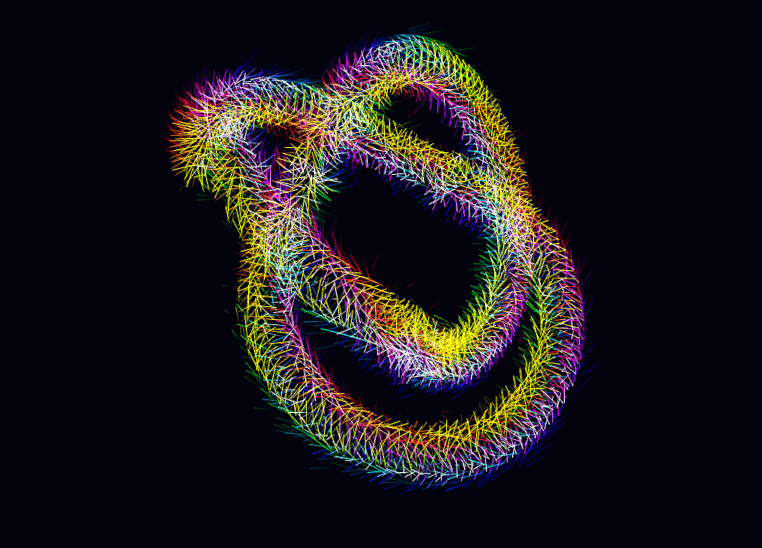
Once the topology has fully committed ($\alpha_{\mathrm{wind}}=1$), the condensate has entered the $\mathcal{Q}_H=3$ baryon sector. At \(T(2,3)\), the Hopfion trefoil's three crossing regions, related by $\mathbb{Z}_3$ symmetry, create three energy barriers. Separating one tube requires simultaneously crossing all three. The universe creates a quark–antiquark pair instead. This is colour confinement seen directly in the energy landscape, matching the topological confinement proved from boundary conditions.
An algebraic checksum: the Jones polynomial
The satellite construction above can be checked against an independent tool from knot theory: the Jones polynomial, a number assigned to any knot or link that stays fixed under smooth deformation and changes only when the topology itself changes. Evaluated at the fifth root of unity that this framework's pentagon structure singles out, the $\mathcal{Q}_H=2$ Hopf link and the $\mathcal{Q}_H=3$ trefoil (built by the satellite construction above) both carry Jones invariants of the same size, $1/\varphi$, differing only by an overall phase — despite being topologically distinct objects, an unknotted two-component link versus a genuine knot.
This algebraic bookkeeping extends to full reactions. Multiply together the Jones invariants of every component on one side of a reaction, do the same on the other side, and take the ratio: the reaction is only permitted at this root of unity if that ratio is a unit — an invertible element of the relevant ring of algebraic integers, a number whose "reaction weight" is exactly 1, neither diluted nor amplified. Both baryon-formation channels above satisfy this rule — two Hopf links combining into a trefoil plus a spectator, and a Hopf link absorbing an unknot directly into a trefoil — each checks out as a unit ratio by direct computation. It functions as a topological selection rule, analogous to a conservation law, but derived from the algebra of knot invariants rather than from a Lagrangian symmetry.
The neutrino sector: $\mathcal{Q}_H = 1$
Below the lepton sector sits the lightest topological excitation of the condensate. The $\mathcal{Q}_H = 1$ Hopfion carries a single unknotted preimage circle with zero writhe, no crossings, and no Y-junction. Its McKay group is $\mathbb{Z}_2 = \{\pm1\}$, the simplest possible binary group, placing it in the A-type (cyclic, abelian) series of the ADE classification — in contrast to the E-type exceptional groups organising leptons ($\hat{E}_8$) and baryons ($\hat{E}_6$). The full McKay chain is $\mathbb{Z}_2 \leftrightarrow \hat{A}_1 \leftrightarrow \mathrm{SU}(2)_1$.
Colour exclusion follows from a coprimality argument: $\gcd(|\mathbb{Z}_2|, |\mathbb{Z}_3|) = \gcd(2,3) = 1$. The colour group $\mathbb{Z}_3$ has no non-trivial action on $\mathbb{Z}_2$-representations. String tension vanishes identically (no crossings, no Y-junction). The sector is maximally free: colour-free, unconfined, and organised by the minimal A-type group. This matches neutrinos' status as the lightest, charge-neutral, colour-neutral fermions of the Standard Model.
The Wess–Zumino descent for the $\mathcal{Q}_H = 1$ condensate forces its own WZW level to $k = 1$ (not the ambient $k = 3$) via the McKay relation $Q_{\mathrm{group}}^{(\nu)} = 2(k+2) = 6$. A critical consequence: the $j = 1/2$ primary of $\mathrm{SU}(2)_1$ is self-conjugate ($j^* = k - j = 1/2 = j$), generating a $\mathbb{Z}_2$ fusion group. It is a Majorana simple current. The framework predicts Majorana neutrinos from the WZW structure alone, independently of any mass mechanism.
The principal quantitative output is a parameter-free mass prediction:
derived from $T_{\mathrm{CMB}}$ alone, with zero free parameters. The $\varphi^{12}$ prefactor comes from $Q_{\mathrm{group}} = 6$, and $e^{-5/144}$ from the $\mathrm{SU}(2)_1$ T-matrix correction. This lies within the final target sensitivity of the Project 8 experiment ($m_\beta \geq 40\;\mathrm{meV}/c^2$ at 90% CL). A non-detection by Project 8 at its design sensitivity would falsify the framework's $\mathcal{Q}_H = 1$ sector identification.
The atmospheric neutrino mass ratio $m_{\nu_3}/m_{\nu_2}$ is derived from the inter-sector coset $\mathrm{SU}(2)_3/\mathrm{SU}(2)_1$, whose four primary fields have T-matrix phases $\{-4, -1, 11, 14\}/30$ with gap structure $(1/10, 2/5, 1/10)$. The atmospheric pair, separated by the outer gap $\Delta T = 1/10$, gives
at $Q_{\mathrm{eff}} = 2\pi/\sqrt{5}$, matching the experimental value $5.795$ to $0.9\%$. Every parameter of the coset — level assignments, Q-groups, gap structure, $Q_{\mathrm{eff}}$, and framing independence — is determined exactly by the trefoil's winding numbers $(p,q) = (2,3)$.
The same $\mathrm{SU}(2)_3$ S-matrix that generates the mass towers above also fixes a leading-order value for the solar neutrino mixing angle, $\tan\theta_{12}^{(0)} = S_{00}/S_{01} = 1/\varphi$, giving $\theta_{12}^{(0)} \approx 31.7°$ against the measured $33.4°$ — a starting point rather than an exact match, with the remaining gap attributed to sub-leading corrections not yet worked out.
The energy cascade: An initial exploration as to how the trefoil decays
The numerical simulations of the $\mathcal{Q}_H = 3$ baryon suggest that it does not decay via the crossings exploding outward. The field data show the opposite: the crossing vertices are topological bottlenecks where $\rho_{J_4}$ (the topological flux density) is minimised, not maximised. Energy is concentrated in the A-segment bodies (the 90° arcs between midpoints and crossings, carrying 79% of the total $J_4$), depleted at the crossings themselves.
The crossings act as topological lenses. Incoming energy from the A-segment is redirected at the crossing and exits at the B-segment departure zone, immediately past the crossing vertex. The full causal chain is: midpoint break → A-segment propagation → crossing redirection → B-departure exit → lobe secondary emission. The three primary jets are therefore coplanar in the $z = +r_0$ horizontal plane, $120°$ apart. The jet energy ordering from hardest to softest is four groups of three:
- Jets 1–3: B-departure exits (hard, coplanar at $z = +r_0$, one per crossing)
- Jets 4–6: Distal lobe secondaries ($\approx$16–19° off the three-jet plane)
- Jets 7–9: Crossing approach-side entry disturbances (softer)
- Jets 10–12: Midpoint torsion-twist residuals (softest)
The topological upper bound is 12 jets per baryon — a prediction with no analogue in perturbative QCD, which has no hard limit on jet multiplicity. The 4th jet (first lobe emission) is deflected $\approx$16–19° below the three-jet event plane, a discrete geometric prediction. An anomaly at precisely this location in four-jet Bengtsson–Zerwas angle distributions, at high invariant mass $m_3 + m_4 > 10\;\mathrm{GeV}$, has been reported in the OPAL data at LEP (Jeremie et al., 2006).
The $\varphi^*$ prediction: baryon vs photon jets
The three-jet event plane orientation distribution from baryon-initiated $\rho^+\rho^-$ production follows the Botner form with a $\cos 3\varphi^*$ modulation (from the trefoil's $\mathbb{Z}_3$ symmetry):
where $\beta_3 \approx 0.58$ is derived from the A/B arc-segment energy ratio with zero free parameters. In contrast, photon-initiated production from $e^+e^- \to q\bar{q}g$ gives $\cos 2\chi$ (from the $\mathbb{Z}_2$ of the spin-1 photon, measured by Botner/DELPHI in 1992). The two signals differ in angular frequency (3 vs 2) and have no common parameters. They are unambiguously distinguishable at any existing or future collider.
Isospin from the writhe: the first quark mass-scale prediction
The trefoil has a $\mathbb{Z}_2$ writhe asymmetry: three crossing vertices sit at $z = +r_0$ (above the equatorial plane), while midpoints and distal lobes sit at $z = 0$. The exit tangent z-components at these sites are exactly $0$ (crossings), $-0.525$ (midpoints), and $+0.321$ (lobes) — all determined by the trefoil geometry alone. Associating the crossing network with up-type quarks (charge $+2/3$) and the midpoint/lobe network with down-type quarks (charge $-1/3$), the geometric-mean mass scale ratio between the two isospin triplets is predicted to be
The observed value (from PDG quark masses) is $M_{\rm down}/M_{\rm up} = (m_d m_s m_b)^{1/3}/(m_u m_c m_t)^{1/3} = 0.157$. This is a 21% match with zero free parameters — an inital coarse but real numerical connection between the trefoil's exact geometry and the observed two-triplet quark mass hierarchy, and the first such connection derived from the framework, to be refined further. The intra-triplet hierarchy ($m_u \ll m_c \ll m_t$) remains an open problem for future work.
So why don't we see any of this compression or prediction with our current physics theories? Because they are all averages of observations. Every observation is averaged into a theory. Lorentz invariance is an average. Isotropy is an average. The "laws" of physics that look universal and exact are statistical averages over all angles, all directions, all phases. The discrete structure beneath the \(\sin^4\theta\) anisotropy, \(\varphi^6\) suppression, the icosahedral symmetry, all of it, is washed out by the averaging process.
Quantum Field Theory averages over all field configurations. General Relativity averages over all coordinate systems. The Standard Model averages over all directions. The averaging is methodologically correct for building effective theories that work in the high-density, high-\(\rho\) regime where we live. But it hides the fundamental discrete structure.
Even quantum chromodynamics produces no $\varphi$-dependent predictions, but that is the framework respecting its own architecture. The icosahedral symmetry that writes $\varphi$ into the electroweak sector and into the lepton masses stops exactly where $\mathrm{SU}(3)$ begins. The boundary between them is the boundary between $2I$ and its $\varphi$-free tetrahedral symmetric subgroup, $2T$.
But once you stop averaging and look at the discrete levels, that is the tower, the WZW primaries, the icosahedral vertices, you see what was always there. The anisotropy that lives in the ratio of a preferred direction to a perpendicular one, in the geometry of icosahedral packing, in the places where rotational symmetry is broken rather than preserved.
A single geometric rule
The universe is not random noise requiring thirty independent dials to match observation. It is a highly structured signal generated by a single geometric rule repeating at different scales. The Golden Tower is that rule made manifest. Particle masses, gauge couplings, gravitational strength, cosmological observables, and even chemical bonds all are harmonics of the same \(\varphi\)-based pattern, separated by factors of \(\varphi^2\) and shaped by the angular suppression \(\sin^4\!\theta/\varphi^6\) that governs how the field flows through itself.
The compression
The Standard Model, General Relativity, and \(\Lambda\)CDM cosmology require approximately thirty measured inputs. The Golden Tower derives those same outputs from one: the CMB temperature \(T_\mathrm{CMB}\).
Thirty-to-one compression, with no free parameters. Whether this reproduction is exact or approximate, that is what the next generation of experiments decides. A value of \(r\) substantially above \(0.0036\) at CMB-S4, a BAO peak not shifted by \(\varphi\), a measurement of \(w_a \neq -3(1+w_0)\) at DESI, a loophole-free lepton Bell test with \(\mathrm{CHSH}\) significantly above \(8/3 \approx 2.667\), a Penning-trap anisotropy measurement inconsistent with \(\Delta m/m_e = 1/\varphi^8\), or a future precision Higgs measurement moving \(m_H\) significantly away from \(125.11\,\mathrm{GeV}\) (from current ATLAS) would rule out the framework. The papers are structured so that judgment can be made cleanly.
Companion Papers
Read the full Density-Feedback FN Hopfion series here:
The Density-Feedback FN Hopfion
The Density-Feedback Faddeev--Niemi Hopfion - Exact algebraic predictions for Standard Model parameters
Paper 1BPS Structure and Fixed-Point Theorem for the Density-Feedback Faddeev--Niemi Hopfion
Companion Paper II in the Density-Feedback Faddeev--Niemi Hopfion Series
Paper 2Two Constants from One Knot: The Fine Structure Constant and the Linking Scale as Exact Predictions of the Icosahedral WZW Condensate
Companion Paper III in the Density-Feedback Faddeev--Niemi Hopfion Series - Fine structure constant and linking scale from WZW condensate
Paper 3The Hopf Spoke, WZW Fermion Mass Renormalization and Three- and Four-Term Formulas for the Fine Structure Constant
Companion Paper IV in the Density-Feedback Faddeev--Niemi Hopfion Series
Paper 4Colour Confinement, the QCD Scale, and Hadronic Structure from the Density-Feedback Hopfion
Companion Paper V in the Density-Feedback Faddeev--Niemi Hopfion Series
Paper 5The Golden-Ratio Tower: Fermion Scale Hierarchy from the Hopfion RG Fixed Point
Companion Paper VI in the Density-Feedback Faddeev--Niemi Hopfion Series -Deriving the $\phi^{-2n}$ tower from RG fixed point
Paper 6Gravity, Inflation, Dark Energy, and Electroweak Structure from the Density-Feedback Hopfion Condensate
Companion Paper VII in the Density-Feedback Faddeev--Niemi Hopfion Series - Emergent gravity and cosmological observables
Paper 7Geometry-Dependent Bell Violations from the Density-Feedback Hopfion
Companion Paper VIII in the Density-Feedback Faddeev--Niemi Hopfion Series - Reproducing quantum Bell violations
Paper 8The Born Rule, the Tsirelson Bound, and the Hurwitz Algebras from the Hopf Push-Forward
Companion Paper IX in the Density-Feedback Faddeev--Niemi Hopfion Series - Tsirelson exact and two distinct CHSH ceilings
Paper 9Quantisation of the Hopfion Condensate: Hilbert Space, Liouville Measure, and the Born Rule
Companion Paper X in the Density-Feedback Faddeev--Niemi Hopfion Series - Geometric quantisation of the Hopfion condensate
Paper 10The Golden-Spiral as a Universal Mass Hierarchy Map: From Condensate Scale to Chemical Periodicity
Companion Paper XI in the Density-Feedback Faddeev--Niemi Hopfion Series - Rydberg energy as a fixed, calculable tower level
Paper 11The Profile Normalisation Conjecture: Proof via CMB Energy Identity, Icosahedral Newton Series, and Two-Route Equivalence
Companion Paper XII in the Density-Feedback Faddeev--Niemi Hopfion Series - Proof via CMB Energy Identity, Icosahedral Newton Series, and Two-Route Equivalence
Paper 12Atomic Quantum Mechanics from the Hopfion Condensate
Companion Paper XIII in the Density-Feedback Faddeev--Niemi Hopfion Series - the Schrödinger equation, spin-½, Fermi statistics, and Pauli exclusion derived as theorems from condensate topology; free-electron mass anisotropy Δm/me = 1/φ8 ≈ 2.13% as a Penning-trap prediction
Paper 13The Thick-Torus Profile Correction to the Density-Feedback Hopfion
Companion Paper XIV in the Density-Feedback Faddeev--Niemi Hopfion Series - the 0.69% electroweak VEV residual resolved to 0.012%; the Higgs mass derived as mH = 125.11 GeV (0.08σ from ATLAS) from the WZW torus partition function
Paper 14The $Q_H=3$ Sector of the Density-Feedback Hopfion
Companion Paper XV in the Density-Feedback Faddeev--Niemi Hopfion Series - Quark charges from the trinification conformal embedding and colour confinement from trefoil topology
Paper 15Quark Generation Masses in the Density-Feedback Hopfion: A Survey of Ruled-Out Mechanisms
Companion Paper XVI in the Density-Feedback Faddeev--Niemi Hopfion Series - Systematic falsification of six quark mass mechanisms; arc-segment energy partition; $Q_H=3$ gradient-flow landscape at $N=192$ and $N=256$
Paper 16The $Q_H=1$ Sector: Topology, Group Structure, Colour Exclusion, and Identification with the Neutrino Sector
Companion Paper XVII in the Density-Feedback Faddeev--Niemi Hopfion Series - WZ descent forces $k=1$; Majorana prediction; parameter-free $m_{\nu_1}\approx42$ meV from $T_{\rm CMB}$; PMNS matrix as exact permutation; atmospheric mass ratio to 0.9%
Paper 17The Pentagon Number: A Unified Proof that the Hopfion Condensate Has Exactly Three Lepton Generations
Foundational Companion to the Density-Feedback Faddeev--Niemi Hopfion Series - Assembles proofs that are distributed across Papers I--VI
Pentagon Theorem Foundational PaperA Reader's Guide to the Density-Feedback Hopfion Series
A Reader's Guide to the Density-Feedback Hopfion Series - A technical companion for readers with background in QFT and GR
A technical companion for readers with background in QFT and GRSource Code and Verification Suite for the Density-Feedback Hopfion Series
Complete code repository for the series - LaTeX sources for every paper, numerical solvers (density-feedback gradient flow, dielectric-cell and two-tube polarizability, Kauffman-bracket/Jones-polynomial engines), and the verification scripts behind the computed claims
GitHub Repository